
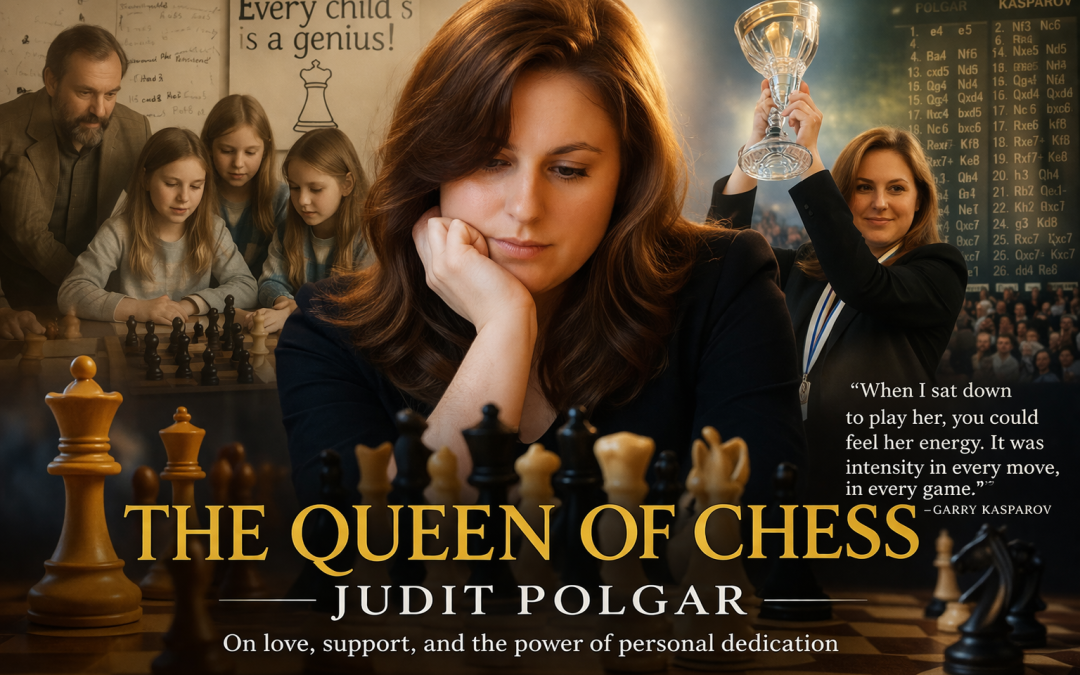
People still debate whether the Polgar sisters were their father’s experiment. The truth is both simpler and far more profound.
Chess is usually associated with strategy, tactics, memory, logic, and intense competition.
Yet the real story of Judit Polgar transcends boards and titles. It is a story of how love, quiet support, and inner dedication can help someone rise above limitations the world tries to impose.
For decades, unwritten rules kept women from the highest levels of chess. Talent was dismissed, and those who challenged the status quo often faced sabotage. Then the Polgar family arrived, and Judit stood out.

Judit Polgár in Queen of Chess. Photograph: Courtesy of Netflix
Chess is an intellectual sport, and you have to believe in yourself! – Judit Polgar
Every Child Is a Genius: The Truth Behind the Polgar Sisters Experiment
One part of her story is often oversimplified, the idea that all three sisters were rigorously trained from childhood and that they were merely their father’s experiment.
Years ago, I read Laszlo Polgar’s book Every Child Is a Genius and realized that behind everything stood only love and the deep sense of responsibility that two adults brought to parenting.
Judit herself emphasizes in one of her books that chess was always her own choice. Her father did not control her; he simply nurtured what the girls had already chosen. He cultivated their curiosity and talent with care.
At the heart of this story is family. The sisters were not rivals, but each other’s greatest support and motivation. Their home became a safe harbor when both the state and the chess world tried to limit them.
Her life partner was another pillar of unwavering support. His presence and understanding allowed her ambition to flourish instead of being restrained. Their relationship is a beautiful example of how important it is for women to have partners who celebrate their dreams, partners who are not threatened by their strength, but who value it and grow alongside them.
That love and security shaped far more than a chess player, they shaped a woman who knows how to focus on her own growth and channel her energy into creation rather than conflict.
That energy did not go unnoticed. Even Garry Kasparov mentioned in the documentary that when he sat down to play against her, he could feel the intensity radiating from her. It was an energy you could sense in every single move and every game.
How Judit Polgar Opened the Door for Women in Chess Without Special Privileges
Judit Polgar did not ask for special treatment or protection. She simply played at the highest level and proved, move by move, that women belong among the chess elite.
Her victories were never about confrontation for its own sake. They were acts of quiet authenticity. Each success became a bridge for those who came after her.
Beyond the Chess Board: Personal Growth and Cultural Change
The documentary Queen of Chess shows that the true lesson is not in the chess results themselves. It lies in how culture, family, partner support, and personal dedication together create the space for genuine potential to flourish.
When harmony reigns within the home, the rest of the world eventually has no choice but to follow. Success becomes a natural outcome
Only the unity of the Polgar sisters saves.
It is not about proving oneself to others, but about existing in one’s full strength. When someone like Judit demonstrates what it means to play with passion, focus, and integrity, a wave of change spreads outward. It does not transform only chess, it changes the way we perceive potential, strength, and what is truly possible in life.
What Judit Polgar’s Story Teaches Us
Judit Polgar’s story is not merely about chess genius. It is a story of love that builds strength, support that liberates, and dedication that inspires. Her family and partnership have shown how deeply love and trust can shape a woman’s power in a world that often challenges her limits.
Judit Polgar did more than defeat grandmasters. She quietly changed long-held beliefs and proved that possibilities are not defined by labels.
Mr. Laszlo Polgar demonstrated that when a child is surrounded by love, support, and the space to grow, she can achieve greatness at the board, and, even more importantly, open the path for others and inspire generations to come. Indeed, every child is a genius.
Unity builds a home.
And perhaps the most fascinating question that remains for those of us watching her story is the one Judit never spoke of directly in the documentary: Where did that extraordinary energy come from, the energy that simply radiated from her, so strongly that even the world’s strongest players could feel it? What was that quiet inner conversation with herself and with something greater than herself that allowed her to play and live with such passion, dedication, and unwavering belief in her own abilities?
That question still lingers in the air, gently inviting each of us to find the answer in our own experiment.
Either you win, or you learn…
Оlgica Đurić started playing chess when she was a little girl. She drew the best from the game, and from the bad things she took lessons. In addition to being a player, Olgica is also a coach, educator, and arbiter, and she is interested in new technologies and psychology.