
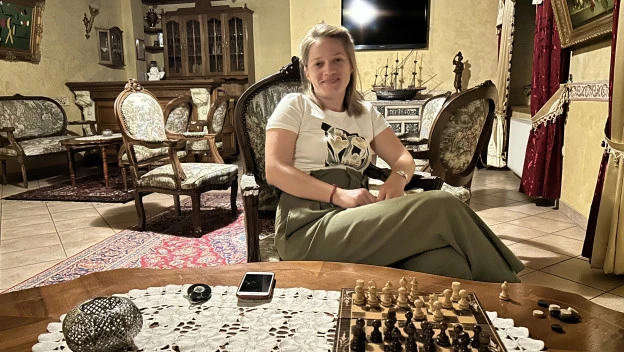
I gave an interview in Serbian to a local newspaper Dnevnik: DNEVNIK’S MONTH OF WOMEN’S CHESS, where we talked about coaching methods, working with children, the position of women in chess and other topics. I am publishing the full version in English on my website. Enjoy it.
Dnevnik: Оlgica Đurić started playing chess when she was a little girl. She drew the best from the game, and from the bad things she took lessons. In addition to being a player, Olgica is also a coach, educator, and arbiter, and she is interested in new technologies and psychology.
How did you step into the world of chess?
Chess lived in our home before me. My mother had a great focus when played. My brother took me to the club “Stevica Puzić – Irig” and coach Preža Nikolić and my father brought me to my first Yugoslav Cadet Championship at six and a half. I was so open I even announced my moves out loud—my first lesson in focus and etiquette.
Early on I met anxiety; when I faced favorites, I wanted to run. My dad would just say, “She’s human too. Play and fight.” That steadiness helped me breathe and stay at the board.
Traveling alone without a coach or computer, I learned preparation, intuition, and to feel both the static and dynamic sides of positions. It was quiet at times, and it built resilience I’m grateful for.
When results arrived and some peers struggled with it, my uncles’ unconditional support kept me grounded.
Although chess is individual, I’m proudest of team wins —helping “Sloven” Ruma and “Šahmatni kružok” Novi Sad earn promotion, and with “Cement” Beočin being named best young athlete of the municipality.
That’s my arc: curiosity, courage under pressure, and contribution to teams.
Dnevnik: Female players often quit chess, or seriously consider it, because of the patriarchal, arrogant, and rude environment they’re exposed to. How can we fight against that?
It’s real: sexism pushes girls out. I’ve seen rule‑bending and intimidation attempts at events.
At one closed tournament, when a favorite tried to alter rules mid‑event, we insisted on fair play through the official process —and the rules held. The lesson isn’t revenge; it’s design.
Respect must be engineered: clear codes of conduct, rapid reporting, independent panels, and visible consequences. Pair that with women‑safe pathways, on‑site ombudspersons, mentorship, and coach education on bias.
When dignity is enforced, girls stay and talent thrives.
Dnevnik: Many girls leave competitive chess when they start university. What do you think is the reason?
I didn’t quit chess when I went to university. On the contrary, I played in leagues and student tournaments while studying at the Faculty of Technical Sciences in Novi Sad, and I played in the ‘menadžerijada’ tournaments for the Higher Business School where I was a scholarship student.
Many women don’t quit chess; they quit the system that stops serving them at 18–20. My generation, especially from smaller towns, lacked information and a roadmap. We didn’t know how ratings worked, which leagues mattered, or that universities abroad offered scholarships for female players. After juniors, tournaments thin out, support drops, and life priorities change — so many drift away.
What helps? Information, structure, and community. Clear pathways for study scholarships, flexible leagues for 18–26, mentors, and mental‑fitness training so results don’t define identity.
The good news: chess is lifelong, as we would say – from 6 to 106. You can step back for studies and return with new goals. Access and design keep women in the game.
Dnevnik: You advocate the view that the process is more important than the trophies and medals. Can you explain that?
I’m against putting trophies and medals first and the process second. Trophies are a bonus; dreaming about them is normal and healthy. When adults project their ambitions, kids learn “I’m worthy only if I win.”
I teach PQ skills so children play from wisdom, not fear. With me there’s no whispering moves or post‑game shaming – just review, questions, and dignity. You won or you learned—often both.
Dnevnik: You lived in the Netherlands for a long time. How would you compare their ‘chess system’ with ours?
The Netherlands runs chess like a system — clear roles, informed parents, upbeat culture, steady steps. We bring passion.
Structure plus heart wins, so in my work I blend our soul with their organization and psychological tools.
Dnevnik: It’s known that chess ‘strikes the ego.’ How can one reduce the influence of excessive expectations and simply enjoy the game?
Chess humbles the ego every game. I used to leave the board judging myself; then I realized chess is a brilliant mirror and a very affordable therapist.

In those hours of quiet, you meet yourself — your patterns, your inner critic, the saboteurs, the “What will they say…?” voices — and you get to choose a cleaner voice. When I start thinking I’m a genius, I remember the eight-year-old who checkmated me at the Novi Sad Chess Club — and I smile.
Every game is self-knowledge training; miss that and the result doesn’t matter. So I listen for the saboteurs and return to presence.
My simple recipe for expectations: practice without attachment, compete with full heart, and enjoy the problem-solving. As Dr. Žarko Ilić says: “Take your expectations away from reality, and the result will be happiness.”
Dnevnik: What has digitalization given to chess, and what has it taken away? How can new technologies further improve this ancient game?
Digitalization has given chess far more than it’s taken: global community, instant training, and equal access. In the past, advantage belonged to geography or a few schools; now knowledge is a choice, not a privilege!
What we must protect is presence and independent thinking. We sometimes lean on engines instead of our own reasoning; the tool is powerful, but wisdom is how we use it.
Tech can keep improving chess by enhancing fairness, learning, and accessibility while preserving what makes this game sacred: human creativity across a board.
Dnevnik: Can you comment on the increasingly frequent cheating accusations in modern chess? And on the introduction of VAR?
Cheating has always existed; forms change. The real issue is intention and consequence: it erodes trust, empties titles, and harms the humans and the game. Chess without trust isn’t chess.
I don’t moralize it; I look at intention and consequence. If someone cheats to feed a family, that’s tragic because it teaches despair. If someone cheats for glory, that’s empty because it kills trust. What do you really gain by taking what you didn’t earn?
I support objective safeguards like VAR to protect fairness and confidence. And I’d add a restorative ‘Court of Honor’: if someone violates the code, they spend a year giving back by coaching kids and seniors, to reconnect with Gens Una Sumus.
Thank you to Stefan Kostić for the interview and the interesting topics we explored.
If you’d like to explore chess with me — not only as a sport, but as a tool for growth, focus, and resilience — you’re always welcome.
Reach out if you’d like more information about private lessons, group trainings, or my PQ approach.
Let’s build something meaningful, one move at a time.