
Every chess player who has competed in open tournaments knows the tension that has nothing to do with the position on the board. That nagging question in the back of your mind. Is my opponent playing their own moves? I have carried that question since the cadet championships, where my father, not a chess player himself, stood guard so I could focus on the game. The problem of outside assistance during games is well known, and it takes many forms.
What I have also learned is that the right organization can take that weight off a player’s shoulders. Serbia Open, the international chess festival held every July in Belgrade, does exactly that. This is my Serbia Open review, and it is why I believe the festival deserves a place on your chess calendar.
Serbia Open. Europe’s Largest Chess Festival in Belgrade
Serbia Open is an International Summer Chess Festival organized by the Chess Federation of Serbia under the patronage of the Ministry of Sports. The 2026 edition, the sixth so far, was held from July 13th to 22nd at the Metropol Palace hotel in Belgrade, a five-star venue on Bulevar Kralja Aleksandra. Over 1000 players from 38 national federations participated, making it the largest chess festival in Europe this year.
The festival is not a single tournament but a full ecosystem. At its core are three FIDE-rated classical events (Masters, Challengers, and Amateurs), each designed for a different level of player. Alongside these, a rating tournament, qualifying blitz events, a rapid tournament, and a final blitz tournament fill every evening and rest day. There is something for everyone. From titled players earning appearance fees to ambitious IMs and FMs chasing their next norm, all the way to club players looking for their FIDE-rated experience.
I have been at the festival twice as an arbiter, part of the team that makes the machinery work. I know what it takes to run a tournament of this scale, because I have done it from the inside. And what struck me was not just the logistics but the atmosphere. The playing hall is elegant and functional. The hotel itself becomes a meeting point. Breakfast conversations between rounds, analysis in the lobby, the kind of chess culture that only forms when the venue and the organization allow it.
Anti-Cheating and Fair Play. What Sets Serbia Open Apart
Anyone who has spent enough time in competitive chess, whether as a player, a coach, or an arbiter, has witnessed various forms of outside assistance being passed to players during games. From electronic devices to signals from coaches and spectators, the problem is real and it is not new. It exists across all levels of the game.
There are also subtler forms of damage. I once had an opponent deliberately forfeit his game against me, not because he could not play, but because he noticed I was having a strong tournament and had a coach preparing me for each round. His rating was higher than mine, and he calculated that the risk of losing was not worth it. He walked away. The result was that I lost a chance at a norm and at rating points I had earned through preparation and good play. That kind of behavior is difficult to address at most tournaments. At Serbia Open, the organizers have made it clear that players who engage in such conduct face sanctions, including being barred from future tournaments in Serbia. That is not a small thing. It means the rules are designed to protect not just the game on the board, but the competitive opportunity itself.
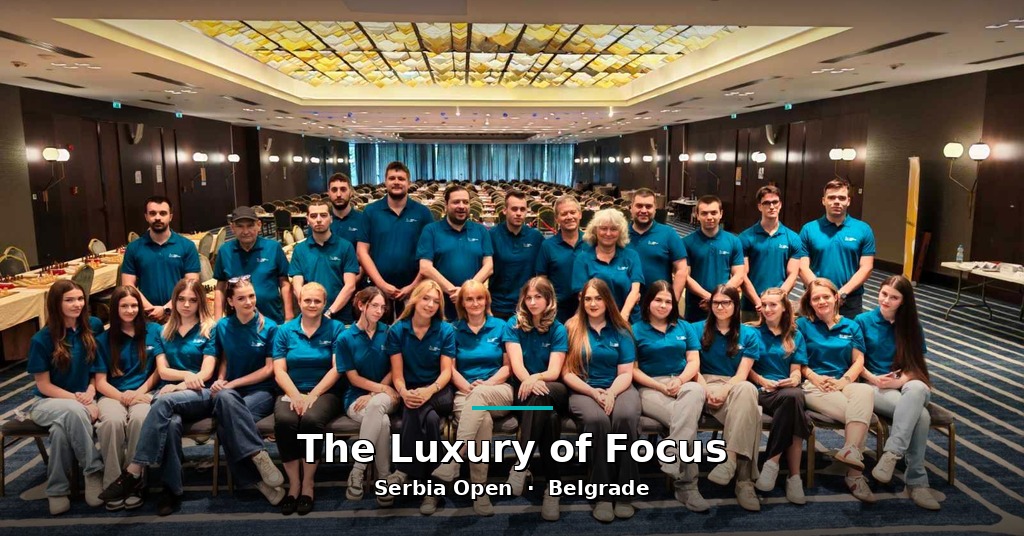
Before a single pawn is pushed, both the arbiters and the Local Fair Play Team (LFPT) work together to set up the entire venue. Boards, clocks, equipment, everything in place. Once the festival begins, the arbiters keep it running. They prepare the hall for each next round, handle pairings, disputes, clock issues, and the inevitable complications of a 1,000-player festival. After the last game is played, they are the ones who pack it all down again. Running a festival of this scale across classical, rapid, and blitz formats is a serious amount of work, and most of it is invisible when it is done well. That is exactly why it should be named.
Both the arbiters and the dedicated fair play team work together to protect the integrity of every game. The LFPT, alongside the arbiters, has its own distinct role. These are separate responsibilities, and both are taken seriously.
The measures are comprehensive. Entry screening before the playing area, random inspections during and after games, electronic detection equipment, statistical analysis of games, and delayed transmission where applicable. Mobile phones, laptops, smartwatches, earphones, USB drives, and any material capable of providing external assistance are all prohibited in the playing area. Even spectators must deposit their phones in designated lockers once the round begins, and they are held to the same regulations as players.
What I appreciate most is the tone. The fair play instructions explicitly state that selection for screening does not imply suspicion. The measures are preventive, applied equally to everyone. This is important. It means that as a player, you can walk into the playing hall and simply play chess. You do not have to wonder about your opponent. You do not have to be the one who catches someone cheating. A dedicated team is taking care of that so you can focus on what you came to do.
When a chess player chooses a tournament, they look at the full picture. Registration fees, prize fund, norm opportunities, FIDE rating, playing conditions, lighting in the hall. Fair play is part of that equation, and at Serbia Open it is not an afterthought. It is built into the structure of the festival, alongside everything else that makes a tournament worth traveling for.
Why This Serbia Open Review Ends with a Recommendation
No Serbia Open review would be complete without saying this plainly. In chess, as in any craft, the conditions in which you practice matter. A tournament that takes fair play seriously is not just offering you a competition. It is offering you the freedom to fully engage with the game. To sit across from your opponent and trust that what unfolds on those 64 squares is honest.
If anything in this Serbia Open chess review stays with you, let it be this. The tournament gave me, as an arbiter, the confidence that the game was being protected. And if I were choosing where to play, not just where to work, it would be this tournament. The question is not whether cheating exists in chess. We all know it does. The question is whether you are willing to play where it is taken seriously.
Belgrade in July. The board is set.
Thank you to the Serbia Chess Federation and the entire organizing team for showing what it looks like when fair play is treated as a foundation, not a footnote.
photocredit: Serbia Open
For tournaments, prizes, registration fees, and accommodation options